
Marketing Analytics
A measurement and data-privacy workflow that transforms website activity into actionable insights for marketing teams.

Case study / 08
context
Digital Analytics
Marketing Measurement
Privacy Compliance
Plumfind contribution
Analytics & Data
Cookie Consent Platforms
End-to-end Implementation
Technology
GA4, Google Tag Manager, Consent Mode, Server-Side Tagging, Google Tag Gateway, AWS
Timeline
Discovery, Measurement Design, Implementation, Optimization
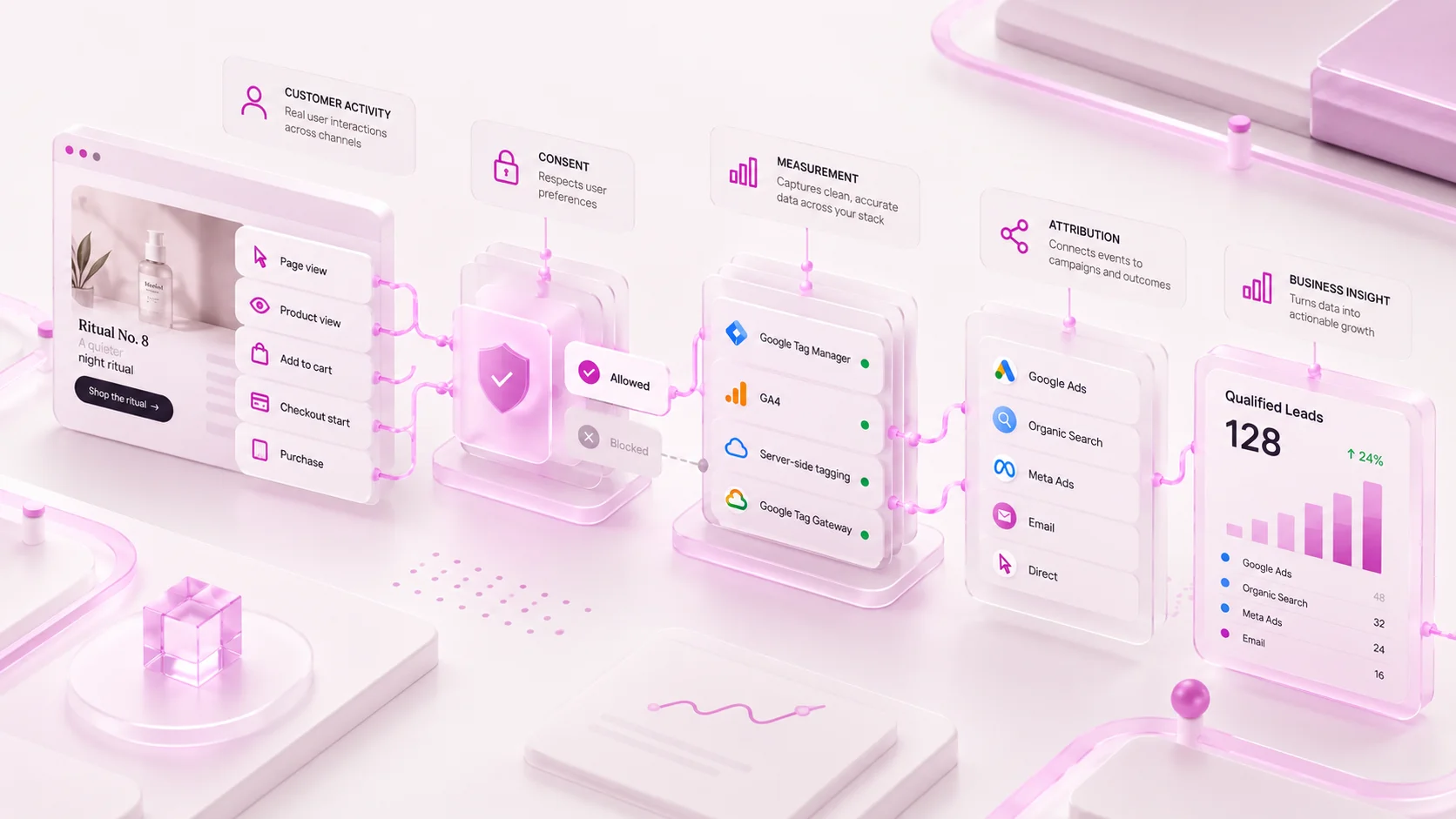
A structured measurement foundation designed to help organizations understand user behavior, improve marketing performance, and maintain compliance in an increasingly privacy-focused business environment.
Overview / the reason to exist
Better decisions require better measurement.
What was built
A privacy-aware analytics and tracking foundation using GA4, GTM, consent management, and modern measurement practices.
Who it served
Marketing teams, analysts, growth teams, and business stakeholders.
Why it mattered
Critical business decisions depended on accurate conversion data, reliable attribution, and compliant data collection.
Businesses weren’t missing traffic. They were missing visibility.
Websites generated valuable customer interactions every day, but inconsistent tracking, fragmented implementations, and evolving privacy requirements reduced the reliability of business insights.
Reduce measurement uncertainty before optimization.
Business context
We began by identifying how users move through the customer journey and which business events truly matter.
Approach
We mapped conversion paths, implemented GA4 event architecture, configured GTM, introduced consent management controls, and established a scalable measurement framework.
Experience direction
Invisible to users but critical to the business: accurate measurement, reliable attribution, and privacy-respecting data collection.
Production plan
Analytics, consent, and tracking infrastructure were implemented with future scalability, governance, and marketing activation in mind.
Research artefact / discovery atlas

Clarity lives in the data.
We mapped business goals, customer journeys, conversion events, attribution requirements, consent rules, and reporting needs before defining the implementation.
Example business question
“Which marketing channels are actually generating qualified leads?”
- Captured through structured conversion events
- Measured through GA4 reporting
- Governed by consent preferences
- Connected to business outcomes
What Plumfind designed and implemented.
A structured measurement framework, consent-aware tracking architecture, and future-ready analytics foundation.
Content model
A structured measurement framework, consent-aware tracking architecture, and future-ready analytics foundation.
Measurement architecture
Business objectives translated into events, conversions, dimensions, and reporting structures.
Consent management
User consent choices integrated into measurement workflows and tag behavior. Consent Mode enables analytics and advertising systems to adjust data collection based on user permissions.
Analytics foundation
GA4 configured for customer journey visibility, engagement tracking, and conversion reporting.
Governance layer
Tracking standards, naming conventions, validation processes, and reporting structures established for long-term consistency.
Solution / architecture
Designed as one clear measurement path.
01
User interactions
Website activity generates meaningful business events.
02
Consent layer
Consent preferences determine how measurement technologies operate and what data can be collected.
03
Measurement layer
GA4 and GTM capture, organize, and route analytics events.
03
Reporting layer
Business stakeholders gain visibility into performance, engagement, and conversions.
DEVELOPMENT
From tracking requirements to a dependable measurement system.
Measurement design
Customer journeys, business events, conversion definitions, and reporting requirements were mapped into a structured analytics framework.
Implementation
GA4 properties, GTM containers, event architecture, conversion tracking, and consent management were configured and validated.
Quality assurance
Tracking plans, event validation, testing procedures, and reporting verification ensured measurement accuracy.
RESULTS
What changed when measurement became trustworthy.
- Established a structured analytics foundation
- Improved conversion visibility across customer journeys
- Reduced measurement inconsistencies
- Implemented privacy-aware consent controls
- Increased confidence in marketing reporting
- Created a scalable foundation for future optimization initiatives
Lesson learned
Optimization is only as good as the measurement behind it.
TECHNOLOGY / SERVICES
Analytics layer
For measuring customer behavior, engagement, and business outcomes through GA4.
Tag management layer
For deploying, governing, and maintaining measurement infrastructure through Google Tag Manager.
Privacy & consent layer
For managing user consent preferences and regulatory compliance through Consent Mode.
Measurement enhancement layer
For improving signal quality, data governance, and conversion measurement through server-side tagging and Google Tag Gateway.
Related projects
Continue through the work.


Start with the business result.
Bring the question you are trying to answer. We will help you decide what deserves to be built.