
Plumfind’s Tariff Bot
Your smart companion for quick, accurate tariff lookups.
Important Disclaimer: Please note that the information provided is intended for demo purposes, and the actual tariff details may not be accurate.

Lightning Fast

Better Accuracy

Live Chat
There are 4 conditions highlighted here:
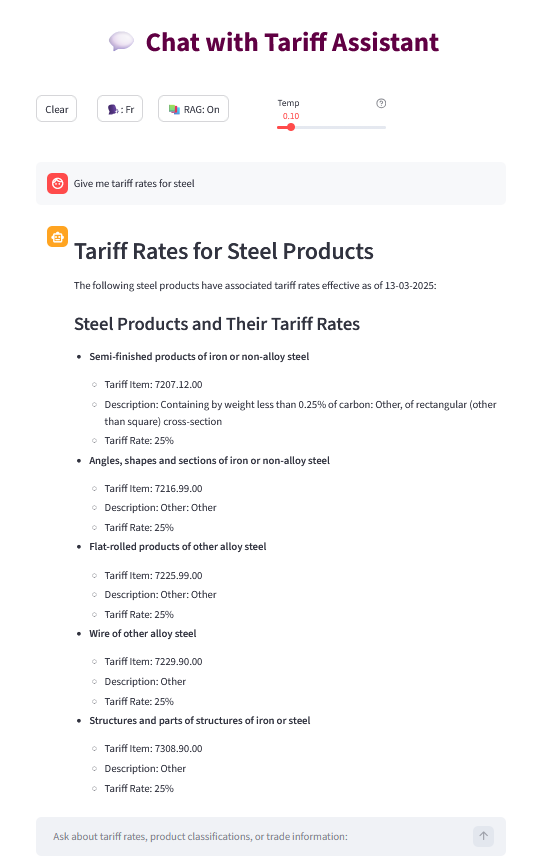
With RAG enabled and temperature set to low, the response is document-grounded with specific HS codes and the same effective date, but the output is noticeably more concise and structured. The low temperature makes the model more deterministic and conservative. It sticks closely to what the retrieved documents say without embellishment or extra explanation. The result is a tighter, more list-like presentation of the same factual tariff data, prioritizing accuracy and consistency over elaboration.
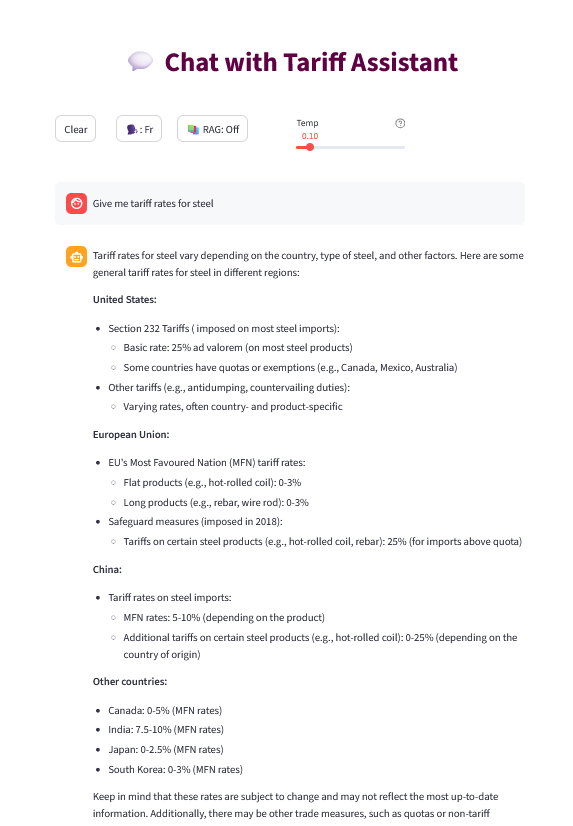
With RAG disabled and temperature at 0.10, the model again relies purely on training knowledge, but the low temperature makes it more cautious and measured in its claims. The response covers similar regional breakdowns (US, EU, China, Canada, etc.) but is more hedged, notably ending with a disclaimer that rates “may not reflect the most up-to-date information.” Compared to the RAG Off/High Temp case, the output is more conservative and slightly less verbose, though it still lacks the document-backed precision that RAG provides.
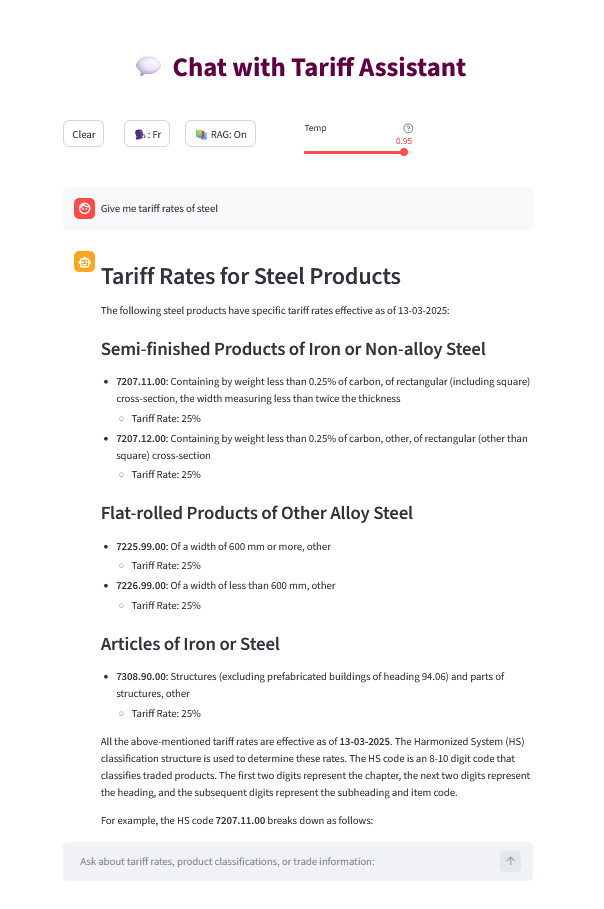
With RAG enabled and temperature near-high at 0.95, the model retrieves specific, document-grounded data — citing exact HS codes (e.g., 7207.11.00, 7225.99.00) and a precise effective date of 13-03-2025. However, the high temperature still introduces some creative latitude in how the response is structured and elaborated, resulting in a rich, detailed answer with additional explanatory context (like how HS codes are broken down). The grounding from RAG keeps the facts accurate, while the high temperature makes the response more expressive and expansive.
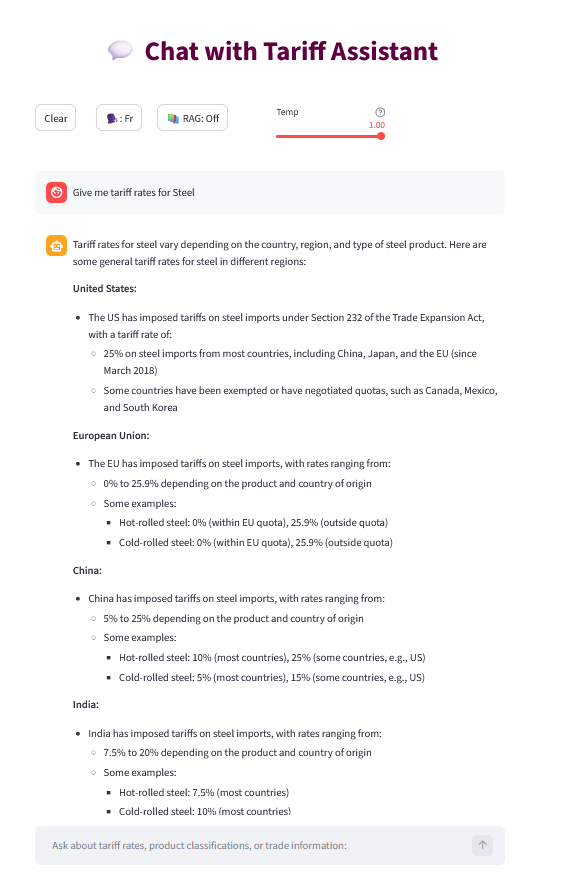
With RAG disabled and temperature set to 1.00, the model generates a broad, general response drawn entirely from its training data. The answer covers multiple regions (US, EU, China, India) with approximate percentage ranges, but lacks precision — figures are rounded and sourced from general knowledge rather than any specific document. The high temperature introduces some variability and verbosity, producing a wide-ranging response that, while informative, could contain inaccuracies or slightly hallucinated figures since nothing is grounding it to verified data.